

A Return to California
Traveling to places from my past and my ancestors' past, seeing family and friends sparks more than memories

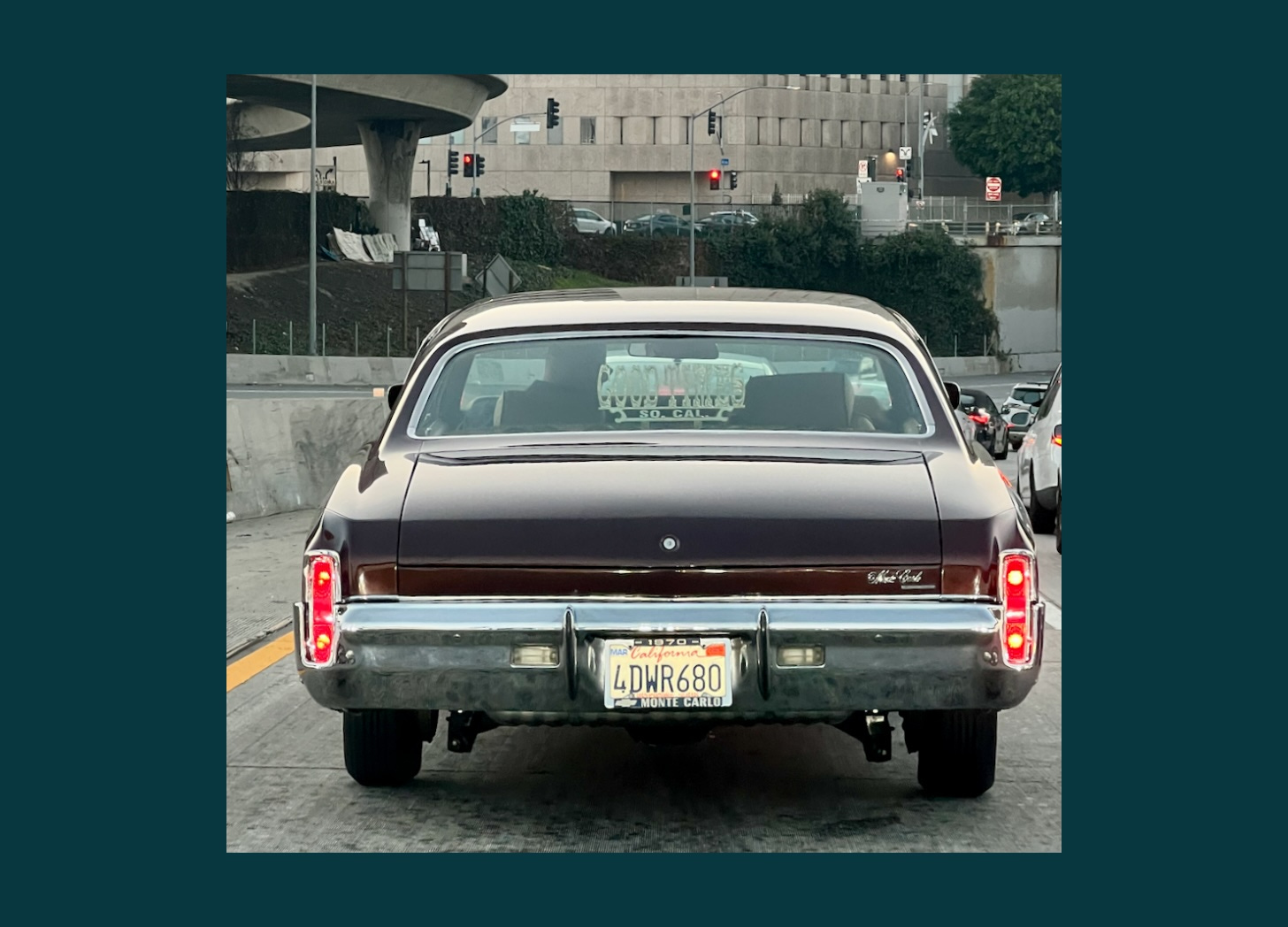
Los Angeles is the distillation of California, the perfection of a dream world of perfect weather, perfect bodies, infinite invention, the seductions of cinema and television, of stars and cars, of long sandy beaches washed by the blue Pacific.
I lived in Los Angeles for nine formative years of my childhood. Well, sort of. We lived out in what Angelenos call “the valley,” the San Fernando Valley, in Woodland Hills. We had horses and chickens and rabbits and even a smelly billygoat, at one point. We also had a pool, citrus trees, an apricot tree, an almond tree, and a sapote tree. Despite the Watts riots, the 1971 devastating earthquake, the smog, the Manson murders nearby, and the Vietnam War broadcast into our living room every evening, it was idyllic.
When I returned to Los Angeles this past weekend, I experienced a strong feeling of the uncanny. It was with me the entire time I was there, visiting my daughter who has elected to make the city I left decades ago her new home.
Even though I know it can’t be, Los Angeles seemed exactly the same as the city I’d known in the 1960s. That made the city seem strange to me, like a revenant from my past.
And not only my past.
My mother’s family settled in the state more than a century ago. My mother was born at Queen of the Angels hospital and lived near Echo Park as a very young child. Her parents, my grandparents, met in Los Angeles in the 1920s, fleeing the hard work and the harder winters of the midwestern farms on which they’d been raised. My grandfather’s family sold their farm in South Dakota and moved to the Danish colony in Solvang in 1911, buying 96 acres of land in Ballard where they started a new farm. A half-century later, my Indian father worked here as an engineer on the Apollo missions and in commercial aviation, and a steady stream of Indian immigrants passed through my Los Angeles childhood home, my mother teaching the sari-clad women how to make srikhand with American sour cream, and taking them out to deserted supermarket parking lots to teach them how to drive.
I am now in San Francisco, where I lived for five years while I was a graduate student at the University of California at Berkeley earning a PhD in the 1980s. The steep hills, the elaborate Victorian houses, the vistas of the bay: This trip has stirred up a lot of memories of those years as well. I have met family members I hadn’t seen in years and years, people who were young children the last time I saw them and who are parents of teenagers now. We pored over old glass negatives of family photos from the 19-teens, and shared memories of the times we spent together forty years ago when I was living in this city as a young woman in my twenties.
I have a lot to process and write about this trip but I am still on the move here, dependent on the plans and time of people who love me and whom I love very much. Spending time with them is more important to me during the last few days I have here than writing for Substack. If you can’t understand that, you are farther gone into the digital sinkhole than is healthy.
I will be back with that long-promised saffron post just as soon as I have returned to my desk in France next week.

In January of this year, I published one of my first posts here during the terrible fires that ripped through parts of Los Angeles. I titled it The Hotspots of Memory. I had fewer readers then. I offer it here again, unlocked so that anyone and everyone can read it. It says a lot about what revisiting California now has stirred up in me, a lot about what this place has meant to me and to my family, what California can mean to the millions of people who live here and to the hundreds of millions more who will never come here but who are enthralled by the dreams that spin out of Hollywood and Burbank onto billions of screens and into billions of minds around the world.
Here’s a taste of what I wrote.
Iris in
The sun is setting, taking the heat of the day with it. The new dichondra lawn is cool and soft under my bare, five-year-old feet. My mother is wearing pedal pushers. She is watering the yard with a garden hose. Her long fingers curl around the open end of the hose, forcing the water into a jet that she aims in swaying arcs around the perfectly square backyard. The yard is surrounded by a concrete-block wall. To one side is a fire station. When they aren’t putting out fires, the firemen hoist me up into the driver’s seat of one of their big, red trucks and let me “steer.” My parents’ brand-new stucco house is in a new subdivision in Canoga Park. The house is close to Rocketdyne, where my father has a new job. Aerospace and defense industries fuelled by the war in Vietnam and the space race are booming in Southern California. My father is sworn to secrecy about what, exactly, he is working on. Later, we will learn that it was the retro rockets on the Apollo spacecraft that would allow the vessel to turn around in the vacuum of space and bring the astronauts inside back to earth. Later, my mother told me he ground his teeth at night during those years.
You can read The Hotspots of Memory here. I hope you enjoy it, and I hope you’ll want to read more on Mixed Borders when I return to regular postings next week.

I can imagine how your journey has plunged you into the past. So many memories. I'm glad our paths crossed during that wonderful, tumultuous time in Berkeley. Hope all is well.
Thanks for this! I lived in Los Angeles for 10 years in my 20s. I can still drive most streets (or freeways) there in my mind with my eyes closed. I know Woodland Hills and that area which most people don't know can feel rural depending what property you're on. I like the passage in Joan Didion's essay "Goodbye to All That" where she talks about returning to Los Angeles, smelling the jasmine all around, and knowing she was home. I can still smell that too (with my eyes closed). Enjoy your trip!